What an AI-Native Application Architecture Actually Looks Like
Three architectural bets that solve the problems vibe coding, low-code, and traditional frameworks can't.
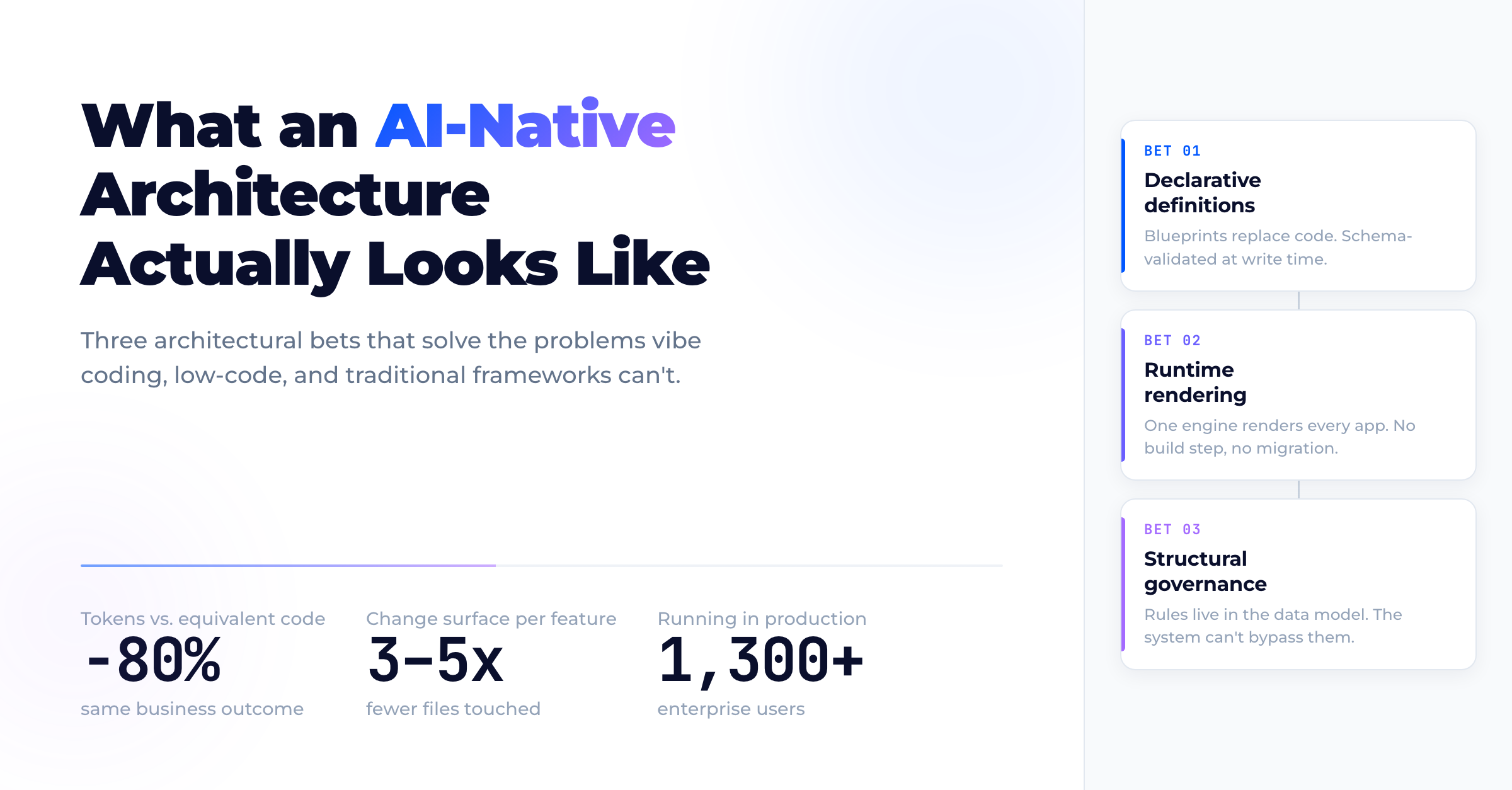
AI coding tools generate code. Low-code platforms avoid code. Both approaches share the same failure mode: the output is a standalone artifact that accumulates its own dependencies, its own upgrade path, and its own governance gaps.
An architecture built for the AI era needs to solve three problems simultaneously: give AI a representation it can work with efficiently, produce real interfaces humans can act on, and enforce governance structurally rather than procedurally. No current approach does all three.
Here’s what one that does looks like.
Bet 1: Declarative definitions replace code
Instead of distributing application logic across hundreds of files, capture the entire application in declarative JSON structures. Call them Blueprints. A Blueprint describes business intent (“this field is required”, “this table displays customer data”), not implementation detail. The schema is extensible. Teams define custom types and properties to fit their domain without forking the framework.
Two consequences follow.
First, the change surface per feature shrinks. Measured against our own production stack, a feature that would touch eight to twelve files in a traditional frontend/backend/test split collapses to a single Blueprint modification — a 3–5x reduction in files touched per change. Fewer files touched means fewer regression paths, fewer merge conflicts, faster reviews.
Second, Blueprints are structured data, stored in a database with schema enforcement and versioned in Git. An AI agent or a human cannot persist an invalid definition. The database rejects it at write time. Errors that would surface days or weeks later in a code-based system never make it past the save. Every change traces to its author, its timestamp, and its approval state.
The token economics matter too. In our production Blueprints, a definition carries 50–80% fewer tokens than the equivalent code for the same business outcome. For LLMs whose accuracy on real-world bug-fixing drops from 29% to 3% as input grows from 32K to 256K tokens,1 that compression is the difference between reliable output and expensive guesswork.
Bet 2: Runtime rendering replaces compiled output
A central Rendering Engine reads Blueprints and generates the complete UI at runtime. No precompiled markup exists. No generated code ships to the client. Rendering happens in milliseconds, indistinguishable from a native application.
This eliminates the upgrade problem. When the Engine ships new components, performance fixes, or accessibility patches, every application inherits the change. No migration scripts. No per-app regression tests. The update deploys once and propagates everywhere.
Because application logic lives in declarative definitions rather than compiled code, customization happens at runtime. No development environment. No build step. No redeployment. Change a Blueprint, see the result immediately.
The Engine is renderer-agnostic. The current production stack runs Vue 3 / PrimeVue on Nuxt 3, but the framework doesn’t care. React, Angular, or any future frontend framework can serve as the rendering target. The Blueprints stay identical. The UI framework becomes a replaceable implementation detail, not an architectural commitment.
For enterprise systems with 10+ year lifespans, renderer independence means the application survives framework churn. Vue to React, React to whatever comes next. The definitions don’t change. The business logic doesn’t migrate.
Bet 3: Governance is architecture, not process
In traditional stacks, governance lives outside the application: linters, code reviews, external audit tools, applied after the fact. The AI finishes, then humans verify. At AI generation speed, that review bottleneck becomes the actual constraint on shipping.
A different approach: governance rules are part of the definition itself.
REST APIs with authentication, authorization, audit trails, and OpenAPI specifications generate directly from Blueprint definitions. Authentication runs through SSO and MFA. Authorization uses relationship-based access control (ReBAC). Every mutation is logged.
Blueprint objects can be pre-approved by any authority: IT defines access controls, marketing owns design tokens, compliance sets data policies. An AI agent builds only with what has been explicitly permitted. It operates within boundaries set before it started, not reviewed after it finished.
This isn’t a policy layer. It’s a constraint of the architecture. The system cannot bypass it. Governance compliance doesn’t depend on someone remembering to run the right check. It’s enforced by the data model.
How the three bets compound
Each bet solves a specific failure mode. Together, they create something none of them achieves alone.
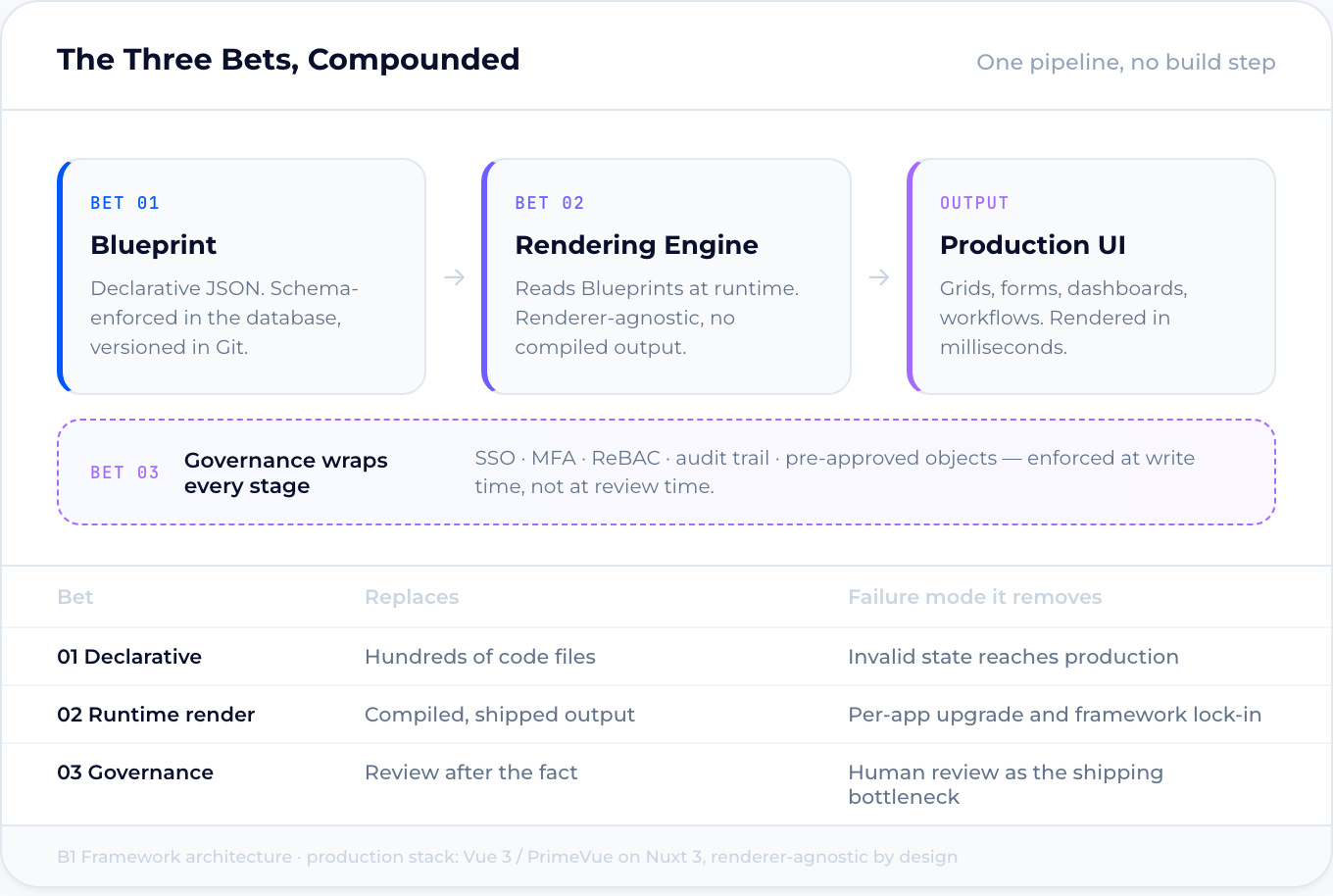
Blueprints give AI agents a structured, bounded representation: fewer tokens, deterministic outputs, schema-validated results. The Rendering Engine turns those Blueprints into production UIs without a build step. Governance ensures that every change, regardless of origin, meets compliance requirements before reaching a user.
Grids, forms, dashboards, workflows, localization, theming. All defined declaratively. All governed. All rendered at runtime.
Where current approaches fall short
Traditional frameworks (React, Vue, Angular) offer full control, but every application is a standalone code artifact. Each one accumulates its own dependencies and governance gaps. AI suitability is retroactive: the architecture was never designed for machine-readable definitions.
Low-code platforms (Retool, Appsmith) solve for speed on internal tools. They don’t address AI-native development, renderer independence, or the governance depth that regulated enterprises require.
Vibe coding tools (Cursor, Bolt, Lovable) accelerate generation. But they generate code. The output is bound by the same frameworks, the same dependency chains, the same maintenance burden. Faster creation doesn’t solve the maintenance problem. It accelerates it.
The gap in the market is an architecture that combines declarative definitions with full code extensibility, a pluggable rendering layer that eliminates framework lock-in, and governance that is structural rather than procedural.
That architecture exists. It runs in enterprise production today — 1,300+ users across 1,000+ screens, managing 25 million documents on a single deployment. Not demos. Not prototypes. Enterprise systems under load, serving real users daily. The question is what gets built on top of it next.
Footnotes
-
Ding et al., “LongCodeBench: Evaluating Coding LLMs at 1M Context Windows,” arXiv:2505.07897 (2025). Claude 3.5 Sonnet accuracy on LongSWE-Bench (bug-fixing task) drops from 29% to 3% as input context grows from 32K to 256K tokens. ↩