AI Without Governance Is Just Faster Risk
When machines build software, the question isn't how fast. It's who's allowed to do what.
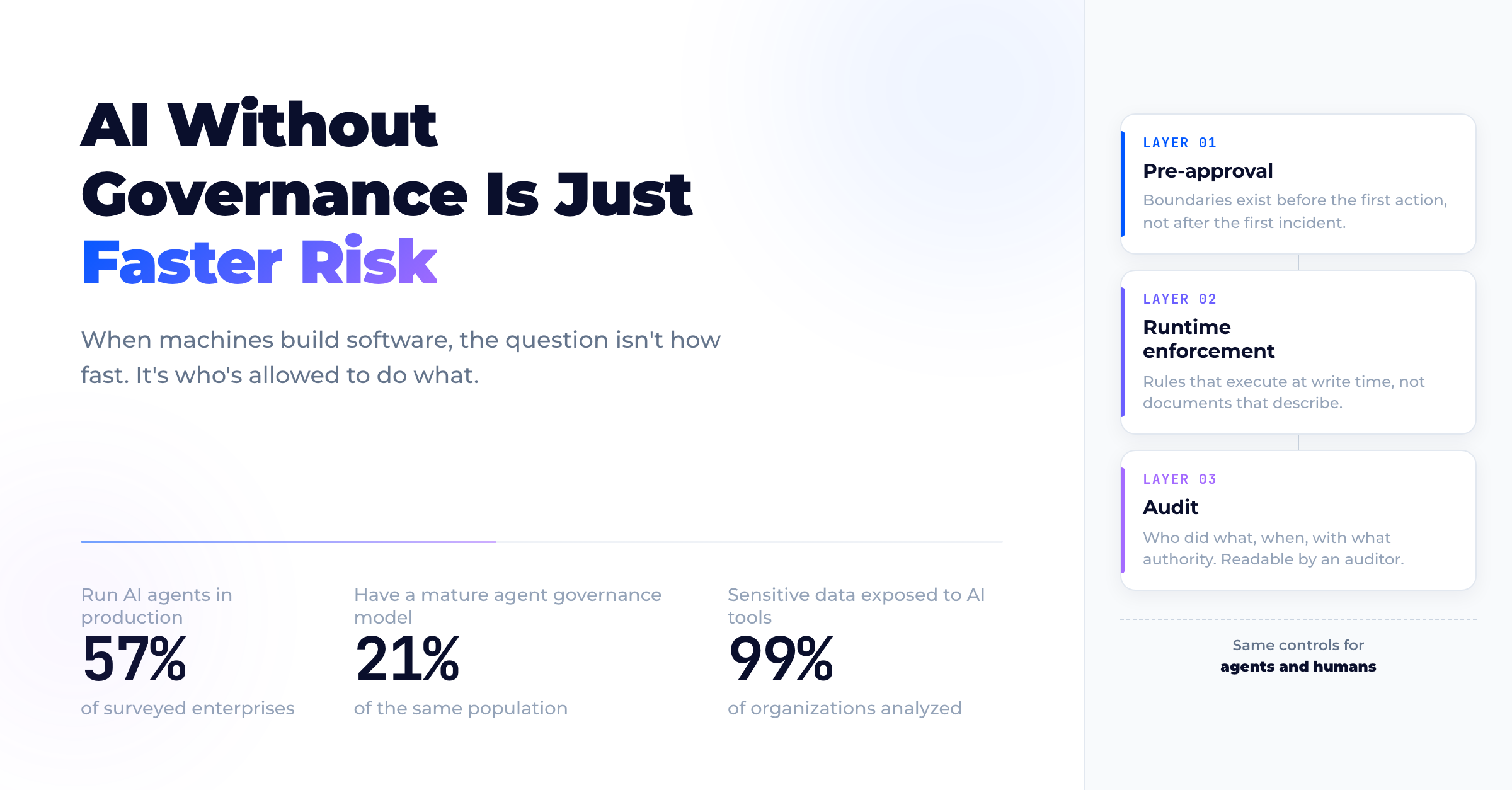
57% of companies run AI agents in production. Only 21% report a mature governance model for those agents.1
Even read charitably, that gap means most production agent deployments operate without structural controls on what the agent can access, create, or modify.
That isn’t a to-do item. It’s the default state of AI-assisted software development today.
Ungoverned by default
The AI productivity conversation has a blind spot. Generation speed gets benchmarked. Token efficiency gets optimized. Context window accuracy gets published. Governance gets deferred to “post-launch hardening.”
Here’s what deferred governance looks like in practice. An AI agent builds a customer dashboard. It pulls data from a CRM, a billing system, and an HR database to populate the view. Which data sources was it authorized to access? Which fields should it have filtered? Which user roles should see which columns? The answers exist in someone’s head, in a policy document nobody reads, or nowhere at all.
Varonis analyzed nearly 10 billion files across 1,000 organizations. 99% have sensitive data exposed to AI tools. 90% have sensitive files accessible to every employee through tools like Copilot.2 The data access problem isn’t theoretical. It’s already happening — quietly, at scale.
When a human developer builds the same dashboard, the governance gaps are identical. But the human builds one dashboard per sprint. The AI builds ten per day. Ungoverned output scales with generation speed.
Three things governance must cover
Most governance conversations focus on one question: “Is the AI output correct?” That’s necessary but insufficient. Structural governance requires three layers, not one — and they apply to AI and humans equally.
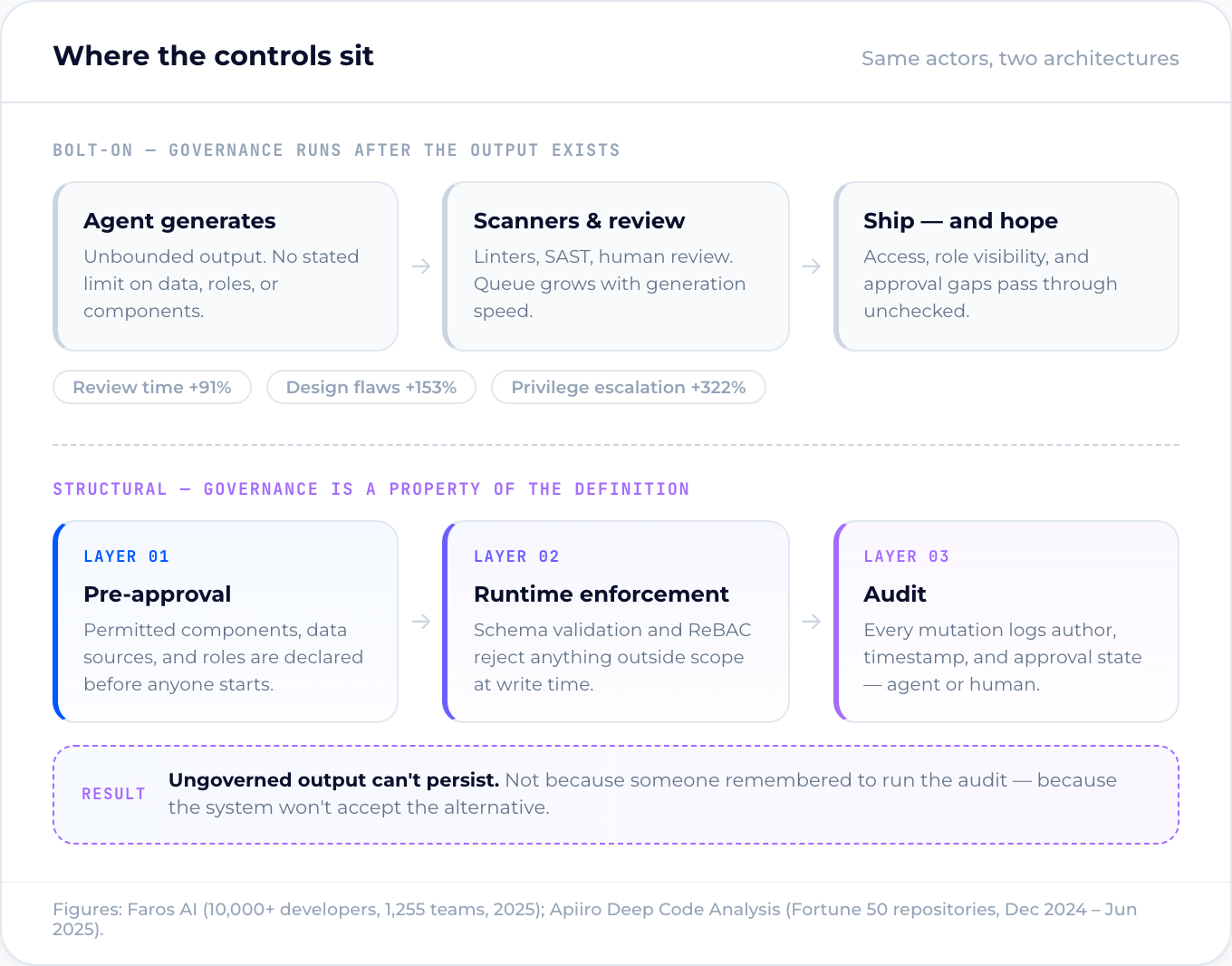
Pre-approval: What’s allowed before anyone starts. What components can the AI use? What data sources can it access? What patterns are permitted? The same questions apply to humans. When a business analyst builds a report, which datasets should they connect? When an AI agent creates a workflow, which services can it call?
Pre-approval means the boundaries exist before the first action, not after the first incident.
Runtime enforcement: Rules that execute, not documents that describe. Access controls, schema validation, permission checks — enforced by the system at the moment of action. Not recommended in a runbook. Not checked in a review three days later. The system rejects unauthorized data access the way a database rejects a malformed query: automatically, at write time, without human intervention.
Audit: Who did what, when, with what authority. Not git blame. Business-level traceability: which user or agent created this view, which data it accessed, which role authorized the action, which approval gate it passed. Audit that an auditor can read — not a developer with ten hours to reconstruct intent from commit logs.
When AI becomes an actor in the system — not just a tool, but an entity with data access and write permissions — the governance model can’t treat AI-initiated and human-initiated actions differently. Both need the same structural controls.
Why bolt-on governance fails
The standard approach: let AI generate, then review. Linters for code quality. SAST for vulnerabilities. Code review for intent. Policy checks for compliance. All applied after the output exists.
This fails for two reasons.
First, speed. At AI generation velocity, post-hoc review becomes the bottleneck. Faros AI’s telemetry across more than 10,000 developers found that teams with high AI adoption merged 98% more pull requests while PR review time rose 91% — and organizational delivery metrics stayed flat.3 Generation got faster. Approval didn’t. The review queue absorbed the entire gain.
Second, scope. Bolt-on tooling is good at exactly the wrong defects. Apiiro’s analysis of AI-assisted commits across Fortune 50 repositories found syntax errors down 76% and logic bugs down 60% — the classes a scanner catches — while privilege escalation paths rose 322% and architectural design flaws rose 153%.4 MITRE rates automated detection of custom authorization schemes as limited, and for good reason: a scanner doesn’t know your authorization model is role-based in one service and attribute-based in another.
Linters don’t check data access permissions. SAST doesn’t verify that a dashboard respects role-based visibility. Code review doesn’t catch that an agent connected to a data source it shouldn’t have touched. The governance enterprises actually need — who can see what data, who can modify which definitions, which actions require approval — lives outside the reach of development-stage tooling.
You can’t lint your way to data governance.
Governance as architecture
A different model: governance rules are properties of the system, not processes around it.
In a declarative architecture, an application’s data access, permissions, and user roles are part of the definition itself. A Blueprint describes not only what a table displays, but which roles can see it, which fields are editable, and which data source it’s authorized to read. The definition is the governance layer.
An AI agent building within this framework can only create objects the schema permits. It can only access data sources that have been explicitly authorized. It can only assign permissions from the available role hierarchy. Not because a policy document says so. Because the system rejects the alternative at write time.
For humans, the same constraints apply. A business user customizing a workflow operates within scoped permissions. They can modify definitions their role authorizes. The system won’t persist changes outside that scope. No exceptions. No workarounds. No “but I need it for a demo.”
Authorization runs on relationship-based access control at object and path granularity. Every mutation logs its author, timestamp, and approval state. Authentication runs through SSO and MFA. The governance layer isn’t added after deployment. It’s the reason deployment works.
What production taught us
Running governed enterprise applications at scale — one deployment of the B1 Developer Framework serves 1,300+ users across 1,000+ screens, managing 25 million documents — produces a specific kind of evidence: what actually breaks in production, and what prevents it from breaking.
The pattern: opinionated constraints outperform flexible permissions. When the system defines what’s allowed rather than what’s forbidden, the attack surface contracts. AI agents produce governed output because ungoverned output can’t persist. Humans see only what their role permits because the rendering layer reads permissions from the same definition the governance layer enforces.
One set of structural boundaries. Two classes of actors. Zero special cases for “the AI did it.”
The shift
The AI era doesn’t need faster governance processes. It needs governance that runs structurally — encoded into the application definition, enforced at write time, auditable by default.
When the system enforces permissions for both AI and humans at the moment of action, reviews intent instead of syntax, and logs every mutation regardless of origin, the question shifts. Not “how do we govern AI?” The system already does.
Footnotes
-
Deloitte, “State of AI in the Enterprise,” 7th edition, January 2026. Survey of 3,235 business and IT leaders across 24 countries: 57% run AI agents in production; 21% report a mature governance model for autonomous AI agents. deloitte.com ↩
-
Varonis, “2025 State of Data Security Report: Quantifying AI’s Impact on Data Risk.” Analysis of nearly 10 billion files across 1,000 organizations. varonis.com ↩
-
Faros AI, “The AI Productivity Paradox,” July 2025. Telemetry from 10,000+ developers across 1,255 teams: +98% pull requests merged, +91% PR review time, +154% PR size, with organizational DORA metrics flat. faros.ai ↩
-
Apiiro, “AI Code Assistants and Security Risk,” 2025. Deep Code Analysis across tens of thousands of repositories at Fortune 50 enterprises, December 2024 to June 2025: syntax errors −76%, logic bugs −60%, privilege escalation paths +322%, architectural design flaws +153%. MITRE’s CWE-862 guidance rates automated detection of custom authorization schemes as limited. apiiro.com ↩